Walla Walla Union-Bulletin · October 18, 1953
Aldrich Brothers Settled Early in Vicinity of Dixie
(Editor's note: This is the 42nd of a series of 52 articles about typical builders who were active in the Walla Walla area during its early development.)
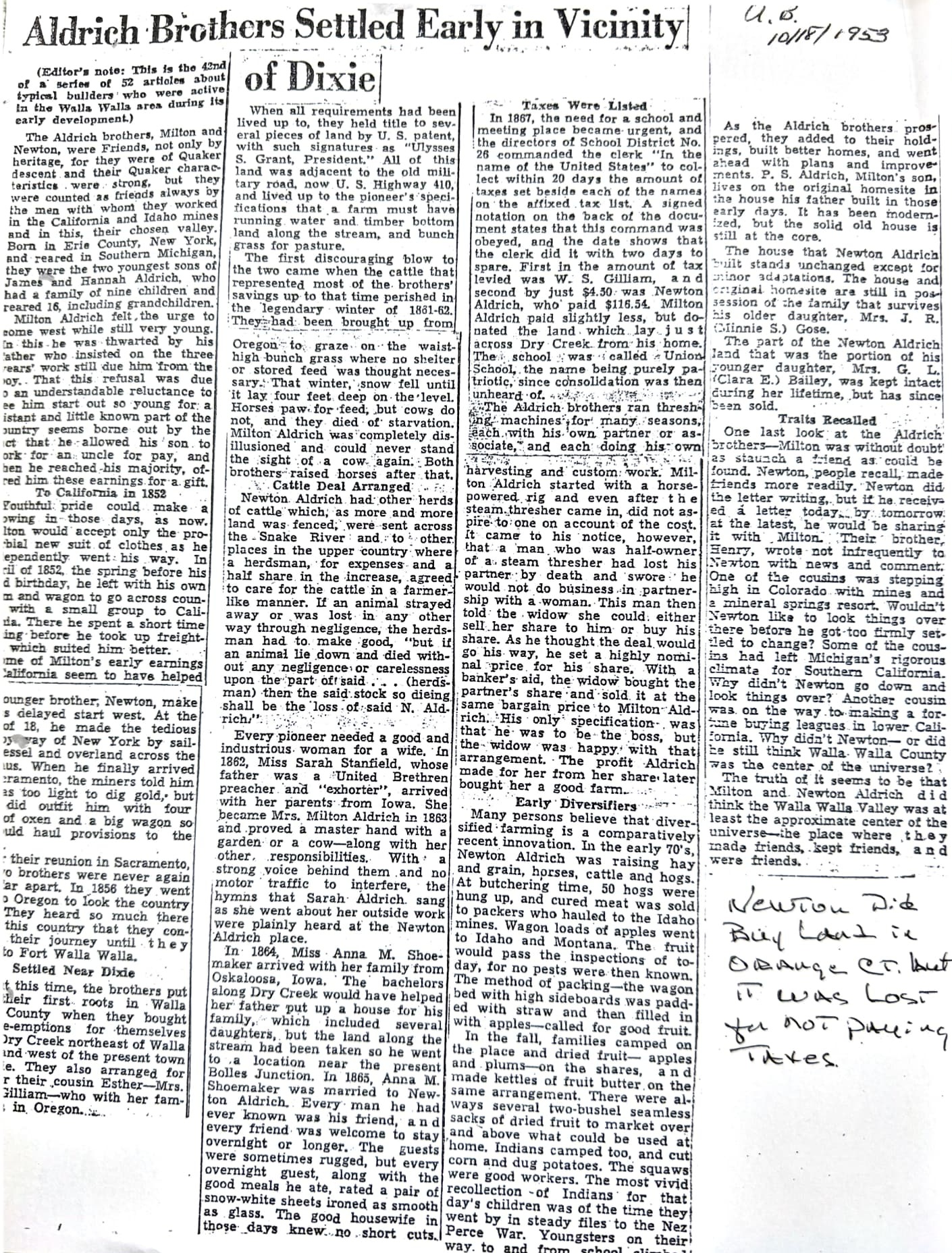
The Aldrich brothers, Milton and Newton, were Friends, not only by heritage, for they were of Quaker descent and their Quaker characteristics were strong, but they were counted as friends always by the men with whom they worked in the California and Idaho mines and in this, their chosen valley. Born in Erie County, New York, and reared in Southern Michigan, they were the two youngest sons of James and Hannah Aldrich, who had a family of nine children and reared 16, including grandchildren.
Milton Aldrich felt the urge to come west while still very young. In this he was thwarted by his father who insisted on the three years' work still due him from the boy. That this refusal was due to an understandable reluctance to see him start out so young for a distant and little known part of the country seems borne out by the fact that he allowed his son to work for an uncle for pay, and when he reached his majority, offered him these earnings for a gift.
To California in 1852
Youthful pride could make a showing in those days, as now. Milton would accept only the proverbial new suit of clothes as he independently went his way. In April of 1852, the spring before his 22nd birthday, he left with his own team and wagon to go across country with a small group to California. There he spent a short time mining before he took up freighting, which suited him better.
Some of Milton's early earnings in California seem to have helped his younger brother, Newton, make a less delayed start west. At the age of 18, he made the tedious trip by way of New York by sailing vessel and overland across the Isthmus. When he finally arrived in Sacramento, the miners told him he was too light to dig gold, but they did outfit him with four yoke of oxen and a big wagon so he could haul provisions to the mines.
After their reunion in Sacramento, the two brothers were never again very far apart. In 1856 they went up into Oregon to look the country over. They heard so much there about this country that they continued their journey until they came to Fort Walla Walla.
Settled Near Dixie
About this time, the brothers put down their first roots in Walla Walla County when they bought out pre-emptions for themselves along Dry Creek northeast of Walla Walla and west of the present town of Dixie. They also arranged for land for their cousin Esther — Mrs. W. S. Gilliam — who with her family was in Oregon.
When all requirements had been lived up to, they held title to several pieces of land by U. S. patent, with such signatures as "Ulysses S. Grant, President." All of this land was adjacent to the old military road, now U. S. Highway 410, and lived up to the pioneer's specifications that a farm must have running water and timber bottom land along the stream, and bunch grass for pasture.
The first discouraging blow to the two came when the cattle that represented most of the brothers' savings up to that time perished in the legendary winter of 1861-62. They had been brought up from Oregon to graze on the waist-high bunch grass where no shelter or stored feed was thought necessary. That winter, snow fell until it lay four feet deep on the level. Horses paw for feed, but cows do not, and they died of starvation. Milton Aldrich was completely disillusioned and could never stand the sight of a cow again. Both brothers raised horses after that.
Cattle Deal Arranged
Newton Aldrich had other herds of cattle which, as more and more land was fenced, were sent across the Snake River and to other places in the upper country where a herdsman, for expenses and a half share in the increase, agreed to care for the cattle in a farmer-like manner. If an animal strayed away or was lost in any other way through negligence, the herdsman had to make good, "but if an animal lie down and died without any negligence or carelessness upon the part of said . . . (herdsman) then the said stock so dieing shall be the loss of said N. Aldrich."
Every pioneer needed a good and industrious woman for a wife. In 1862, Miss Sarah Stanfield, whose father was a United Brethren preacher and "exhorter", arrived with her parents from Iowa. She became Mrs. Milton Aldrich in 1863 and proved a master hand with a garden or a cow — along with her other responsibilities. With a strong voice behind them and no motor traffic to interfere, the hymns that Sarah Aldrich sang as she went about her outside work were plainly heard at the Newton Aldrich place.
In 1864, Miss Anna M. Shoemaker arrived with her family from Oskaloosa, Iowa. The bachelors along Dry Creek would have helped her father put up a house for his family, which included several daughters, but the land along the stream had been taken so he went to a location near the present Bolles Junction. In 1865, Anna M. Shoemaker was married to Newton Aldrich. Every man he had ever known was his friend, and every friend was welcome to stay overnight or longer. The guests were sometimes rugged, but every overnight guest, along with the good meals he ate, rated a pair of snow-white sheets ironed as smooth as glass. The good housewife in those days knew no short cuts.
Taxes Were Listed
In 1867, the need for a school and meeting place became urgent, and the directors of School District No. 26 commanded the clerk "In the name of the United States" to collect within 20 days the amount of taxes set beside each of the names on the affixed tax list. A signed notation on the back of the document states that this command was obeyed, and the date shows that the clerk did it with two days to spare. First in the amount of tax levied was W. S. Gilliam, and second by just $4.50 was Newton Aldrich, who paid $116.54. Milton Aldrich paid slightly less, but donated the land which lay just across Dry Creek from his home. The school was called Union School, the name being purely patriotic, since consolidation was then unheard of.
The Aldrich brothers ran threshing machines for many seasons, each with his own partner or associate, and each doing his own harvesting and custom work. Milton Aldrich started with a horse-powered rig and even after the steam thresher came in, did not aspire to one on account of the cost. It came to his notice, however, that a man who was half-owner of a steam thresher had lost his partner by death and swore he would not do business in partnership with a woman. This man then told the widow she could either sell her share to him or buy his share. As he thought the deal would go his way, he set a highly nominal price for his share. With a banker's aid, the widow bought the partner's share and sold it at the same bargain price to Milton Aldrich. His only specification was that he was to be the boss, but the widow was happy with that arrangement. The profit Aldrich made for her from her share later bought her a good farm.
Early Diversifiers
Many persons believe that diversified farming is a comparatively recent innovation. In the early 70's, Newton Aldrich was raising hay and grain, horses, cattle and hogs. At butchering time, 50 hogs were hung up, and cured meat was sold to packers who hauled to the Idaho mines. Wagon loads of apples went to Idaho and Montana. The fruit would pass the inspections of today, for no pests were then known. The method of packing — the wagon bed with high sideboards was padded with straw and then filled in with apples — called for good fruit.
In the fall, families camped on the place and dried fruit — apples and plums — on the shares, and made kettles of fruit butter on the same arrangement. There were always several two-bushel seamless sacks of dried fruit to market over and above what could be used at home. Indians camped too, and cut corn and dug potatoes. The squaws were good workers. The most vivid recollection of Indians for that day's children was of the time they went by in steady files to the Nez Perce War. Youngsters on their way to and from school climbed [text cut off at bottom of column]
As the Aldrich brothers prospered, they added to their holdings, built better homes, and went ahead with plans and improvements. P. S. Aldrich, Milton's son, lives on the original homesite in the house his father built in those early days. It has been modernized, but the solid old house is still at the core.
The house that Newton Aldrich built stands unchanged except for minor adaptations. The house and original homesite are still in possession of the family that survives his older daughter, Mrs. J. R. (Minnie S.) Gose.
The part of the Newton Aldrich land that was the portion of his younger daughter, Mrs. G. L. (Clara E.) Bailey, was kept intact during her lifetime, but has since been sold.
Traits Recalled
One last look at the Aldrich brothers — Milton was without doubt as staunch a friend as could be found. Newton, people recall, made friends more readily. Newton did the letter writing, but if he received a letter today, by tomorrow at the latest, he would be sharing it with Milton. Their brother, Henry, wrote not infrequently to Newton with news and comment. One of the cousins was stepping high in Colorado with mines and a mineral springs resort. Wouldn't Newton like to look things over there before he got too firmly settled to change? Some of the cousins had left Michigan's rigorous climate for Southern California. Why didn't Newton go down and look things over? Another cousin was on the way to making a fortune buying leagues in lower California. Why didn't Newton — or did he still think Walla Walla County was the center of the universe?
The truth of it seems to be that Milton and Newton Aldrich did think the Walla Walla Valley was at least the approximate center of the universe — the place where they made friends, kept friends, and were friends.
Handwritten at the bottom of the clipping
"Newton did buy land in Orange, CT. but it was lost for not paying taxes."
Transcribed from the clipping above; spelling and wording follow the original.
← Back to the archive